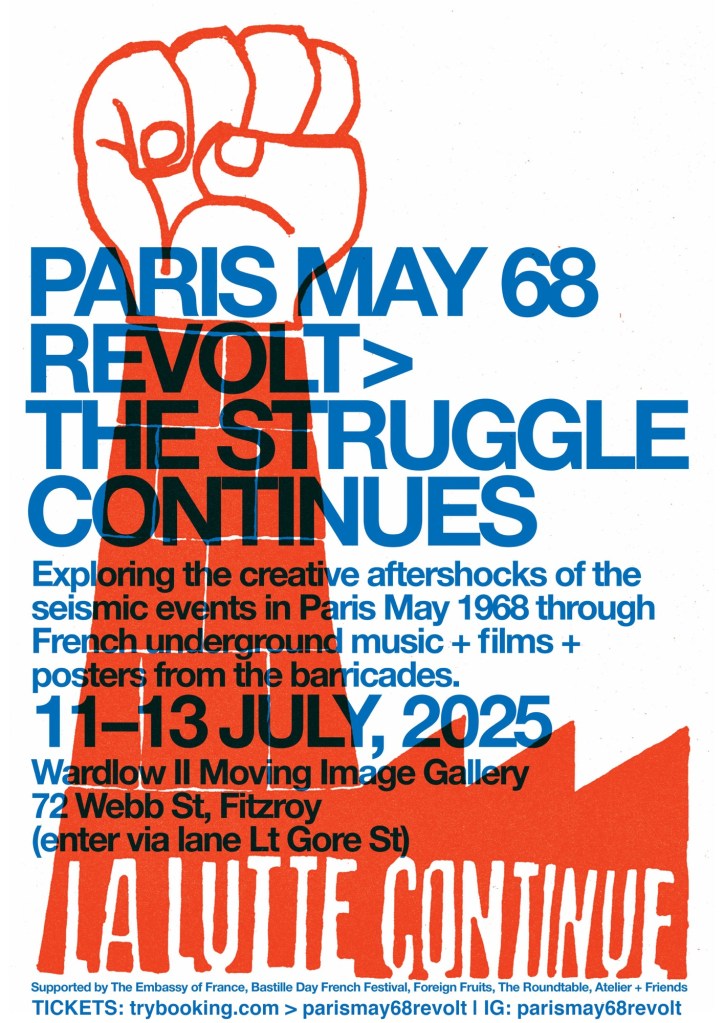
Event info on Instagram
The book launch is a Free event on Saturday 12 July from 5-6PM.
There’s also a whole schedule of events, film screenings etc, with tickets available from Trybooking.
The French Musical Underground 1968-1978
Event info on Instagram
The book launch is a Free event on Saturday 12 July from 5-6PM.
There’s also a whole schedule of events, film screenings etc, with tickets available from Trybooking.
Finally coming in August 2025 – 530 pages packed with information about the ’70s French Underground music scene.
It’s at least 6-8 months until I publish, but I’ve just had a few sample books printed with about 2/3 of the final content. And even at my age I’m pretty damned excited. So I just had to share this!


Well I’m finally getting there… I’ve just completed a first draft of 2/3 of my book – 300 pages. I’ll be sending this out to people who might be able to provide me with a cover endorsement (if they actually like it…)
So what’s completed?
There’s the Introduction, a foreword by Jean-Jacques Birgé, and a history of the French Underground music scene up to 1970.
Then the stories of: Red Noise, Barricade, Maajun, Komintern, Fille Qui Mousse, Bananamoon, Ame Son, Cheval Fou, Nyl, Clearlight, Delired Cameleon Family, Moving Gelatine Plates, and Jac Berrocal.
Finally a Discography, Bibliography, and list of Source material.
Still to come: Heldon, Gong, Magma, Etron Fou Leloublan, Lard Free, Camizole, Philippe Besombes, Birgé Gorgé Shiroc, Zao, Crium Delirium, Dagon, and Ilitch…
I’ve just uploaded two sample chapters to the website. The first is about Daevid Allen’s pre-Gong bands (esp Bananamoon). The other explains the significance of May 68 to the scene.
I’d love to read your comments!
More Ame Son video! This time part of their performance at the legendary Amougies Festival – rescued from the lost film of the event (Amougies (Music Power – European Music Revolution).
This is a very rare piece of French music history!
Ame Son were one of the first underground bands (members had played in Bananamoon with Daevid Allen before he formed Gong).
Here is a previously unreleased live film clip of one of the tracks from their album ‘Catalyse”.
I’ve just compiled a list of the French Progressive/Alternative Rock albums released between 1968-1980 that the musicians have made available to stream on Spotify, Bandcamp, or Soundcloud.
Just click on the “Music Streams” tab above and explore some great music!
Alongside Christian Vander (Magma) and Richard Pinhas (Heldon), Gilbert Artman is one of the major figures of the 70s French music underground. He was the only constant member of Lard Free, a band he formed in late 1970 after he had built a reputation as one of France’s leading young jazz drummers.
This 1973 album is Lard Free’s first release. There is an earlier set of recordings made in 1971/2 (for an aborted album) that has been posthumously released under the title Unnamed. Lard Free’s progression from those earliest recordings, to this album, and onwards through I’m Around About Midnight (1975) and Lard Free (1977) is stunning. It’s not so much that the band improved (much of their earliest music on “Unnamed” is incredible), but rather that Lard Free’s music was in a state of constant flux.
In fact, it’s next to impossible to pin down a “Lard Free sound” – even on a single album. As we’ll see, within the one track Lard Free can radically change direction. Because of this, my approach to Gilbert Artman’s Lard Free here is is to look at it track-by-track.
Side One:
1. Warinobaril (3:46)
The album kicks off with Altman on drums and Hervé Eyhani on bass laying down a relaxed groove that sits somewhere between German Motorik and Jazz-fusion. They’re joined by Philippe Bolliet playing long notes on sax. Though when I say “notes” I really mean “note” – just a single note repeated, sometimes up an octave (or two) just for variety. This sets up a rhythmic and melodic stasis that brings Faust and Neu! to mind, while sounding totally different. It’s all pretty good, but not earth-shattering.
But then, just before the two minute mark, the earth shatters! François Mativet crashes in on guitar, coming on like a derailed freight train. Actually judging by the sound the guitar is making it may well have just been hit by a freight train… because if it ever was in tune, it sure as hell isn’t now!
It seems like François just doesn’t give a fuck about things like “tuning”. Mativet’s guitar work on the whole album is stunning, and here he plays with absolutely no sense of style or decorum, violently slashing across the groove that Altman and Eyhani have set up. However, even in this barely controlled mayhem you can hear echoes of John McLaughlin’s and Pete Cosey’s playing with Miles Davis. As the album continues it becomes more and more obvious that Mativet is a great player, for whom breaking the rules is the norm.
Finally in a flurry of feedback delay Warinobaril comes to a dead halt.
2. 12 ou 13 Juillet que je sais d’elle (8:48)
The second track is a totally new departure – and like the first it is in two parts, but this time officially. For Part 1 repetition is still the watchword, this time the foundation is laid by a wonderfully throbbing sequence played on an ARP synthesiser by Eyhani. Sensuously long sax lines from Bolliet sit in a shimmering halo of reverb. Eyhani shows real talent in constantly morphing the timbre of the ARP – so while the sequence chugs relentlessly onwards, the sound never stops evolving, keeping our interest fixed.
This ability to incorporate continuously evolving but highly-repetitive synth lines is something that Richard Pinhas from Heldon also mastered. In my view, it is one of the hallmarks of the French underground sound. Using synthesisers in this way is very different from the styles favoured by either the German or the British bands of the time. In many ways the seeds of European Techno are being sown in tracks like 12 ou 13 Juillet que je sais d’elle (so the rise of Daft Punk and French House may not be as surprising as we Anglophones first thought).
Part 1 ends with the synth line becoming more and more randomised while Bolliet’s gorgeous saxophone continues, oblivious to what could easily be a technical breakdown.
Then there is a jump cut from this polished soundworld of fluid synth and sax into the blast of primal punk-jazz-fusion that is Part 2. Here we get the first indication of Lard Free’s jazz-improv background. Mativet continues to reveal what an accomplished guitarist he is – lines that initially sound like he is just scrabbling always end on the perfect note. Bolliet shows some of his capabilities as a post-bop saxophonist, although his playing is still much more restrained than the free-jazz stylings you can hear on the Unnamed recordings from the year before.
It’s hard to see the relationship between Parts 1 and 2 of 12 ou 13 Juillet que je sais d’elle, but between them lies the full musical scope of this album – so it is somehow fitting that this is presented as single piece.
3. Honfleur écarlate (4:48)
Hervé Eyhani starts proceedings with a simple mesmerising bassline. The drums and saxophone gradually join in creating a slightly tense, almost funky vibe that could be used to soundtrack a 70’s drug stakeout. Then Mativet screams in with a fuzztone guitar that is equal parts psychedelic and jazzy, but is so lo-fi that it really does sound like he’s amplifying his guitar through a transistor radio… one with a seriously buggered speaker. The combination of the odd funkiness of the rhythm section, Bolliet’s controlled sax playing and Mativet’s anarchic blast expands on the promise of the opener Warinobaril, making Honfleur écarlate perhaps the definitive statement of this incarnation of Lard Free.
Side 2
1. Acide framboise (6:45)
For me Acide framboise is the one point on this album where the compromises caused by Lard Free’s lack of studio time show through. It has the feel of something quickly thrown together in the studio, lacking the direction and intent of the tracks on Side One. Eyhani’s synth bassline has none of the sonic excitement from earlier, Mativet meanders around on a guitar on the brink of feedback, and Artman joins in with a fairly straight beat. Once the scene is set there is little musical movement, although towards the end of the track Eyhani tries out different variations on his bassline, but gets nowhere particularly interesting.
2. Livarot respiration (7:50)
Livarot respiration is a return to form, and offers up a welcome change of pace with its floating ambiance. Here Artman changes instrument, moving from drums to vibes. His playing has a deliciously relaxed summery feel, with a free flow. He is joined by Eyhani on bass and Bolliet on breathy soaring saxophone. When Mativet finally joins in he plays with remarkable restraint, his playing still shows some of the spikiness we’ve come to expect, but here he leaves plenty of space between his beautifully-judged flurries of guitar. This is a really beautiful piece.
3. Culturez-vous vous même (4:40)
Coming after Livarot respiration this track’s layered synth drones bring’s Lard Free’s first album to a satisfying soft landing. These drones slowly drift from unison, through non-musical intervals, then back to unison, veering into a gentle distortion at times. The fact that the drones never actually harmonise in a musical sense keeps the listener’s interest in a track that could so easily veer into the monotonous. Artman finally joins in on a reverberating piano for the final minute adding some sparkle and a sense of completion to a track that has to this point defiantly refused to resolve.
And should you wish to experience the album for yourself (which I obviously recommend!) here it is for your listening pleasure:
 Synths, Sax & Situationists